
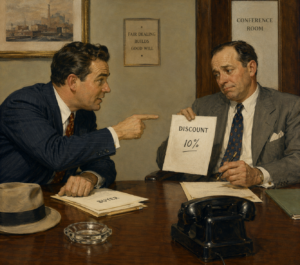
Your sales team just lost a deal on price.
Again.
The prospect said it was too expensive. Your rep came back asking for approval to discount. You approved it — or you didn't — and either way something felt wrong.
Here's what actually happened. The prospect didn't reject your price. They rejected your story.
Price is not a number. Price is an exchange of value. This for that. And the moment a buyer says "that's too expensive," they are telling you something specific: the story your sales team told them doesn't match the number on the proposal. The reputation you've earned, the value you've communicated, the problem you've helped them see — none of it added up to the price on the page.
You probably don't need a lower price. You need a better story.
What Price Actually Measures
Most salespeople treat price as a function of cost. Raw materials plus labor plus margin equals number. That's accounting. That's not selling.
Price is based on value — not on what it costs you to produce. A bottle of water at a gas station costs less than the same bottle at a stadium. Same water. Different story. Different context. Different value.
The buyer isn't paying for the product. They're paying for what the product means to them in that moment — what problem it solves, what risk it eliminates, what outcome it makes possible. Your job is to understand that story before you ever quote a number.
Most salespeople skip that job entirely. They ask "what's your budget?" early in the conversation and call it qualifying. It isn't. It's lazy. It's selfish. It hands the pricing conversation to the buyer before you've earned the right to name a number.
Your job is to figure out what your client wants, what they're afraid of, and what kind of story they are eager to buy. The price comes after that. Not before.
The Story Your Buyers Are Already Telling Themselves
Every buyer walks into a conversation with a story already running. They have a budget not because that's all they can spend — but because that's all they're willing to spend on what they think you are.
Change what they think you are and you change what they're willing to spend.
This is why "it might not be for you" is one of the most powerful phrases in sales. It signals that you make the best — for someone. Not for everyone. The right buyer hears that and leans in. The wrong buyer walks. That's not a loss. That's a sifter working correctly.
The customers you win because you're the cheapest are the first ones to leave when someone else is cheaper. You haven't earned loyalty. You've earned a transaction. And transactions have no memory.
The most resilient position in any market is this: "You'll pay a bit more, but you'll get more than you paid for." That sentence builds a different kind of buyer. One who stays. One who refers. One who doesn't call you when a competitor sends them a lower quote.
What Your Sales Team Is Actually Doing
Here's where this gets uncomfortable.
When your CEO closes deals, price rarely comes up the same way. You don't lead with features. You don't wait for the prospect to bring up budget. You talk about what the buyer is losing by staying where they are. You frame the value before you name the number. You make the decision feel inevitable.
Your sales team doesn't do that. Not because they're incapable — because they were never given the story.
They have a price sheet. They have a product deck. They don't have the narrative that makes the price make sense. So they improvise. They list features. The buyer hears noise. The buyer asks for a discount. The rep gives one.
And there's a component of value your team almost certainly underestimates entirely: convenience. The ease of working with you. The reliability. The responsiveness. The fact that problems get handled before you have to ask. Convenience is a story too — and most sales teams never tell it.
Bargains and discounts have their own narrative. A well-structured promotion creates urgency and perceived value. But discounting because your team can't defend the price is different. That's not a strategy. That's a surrender.
The Destination: A Sales Team That Sells on Value
Imagine a sales team that walks into every meeting with the story that closes.
That knows the buyer's fears before the buyer names them. That frames your product as the only logical choice before price is ever discussed. That doesn't ask "what's your budget?" — because they've already made the budget irrelevant.
Dan Kennedy has a phrase for what happens when the story is right: category of one. Not the cheapest. Not the most features. The only one that makes sense for this buyer. Price becomes a secondary conversation. The margin holds. The discount requests stop. The CEO stops getting pulled into deals to save them.
Your sales story — the one that closes every time you tell it — finally lives in your team, not just in your head.
That's not luck. That's a playbook.
The First Step
The Sifter Message is a four-hour facilitation that extracts your CEO's natural sales genius — the positioning, the unique mechanism, the value story — and builds it into an arsenal your entire sales team deploys from day one.
One buyer persona or two. One playbook. Your sales story, for every seller, for every deal.
If your sales team is discounting deals you would have closed at full margin, the resource below is the right next step.
