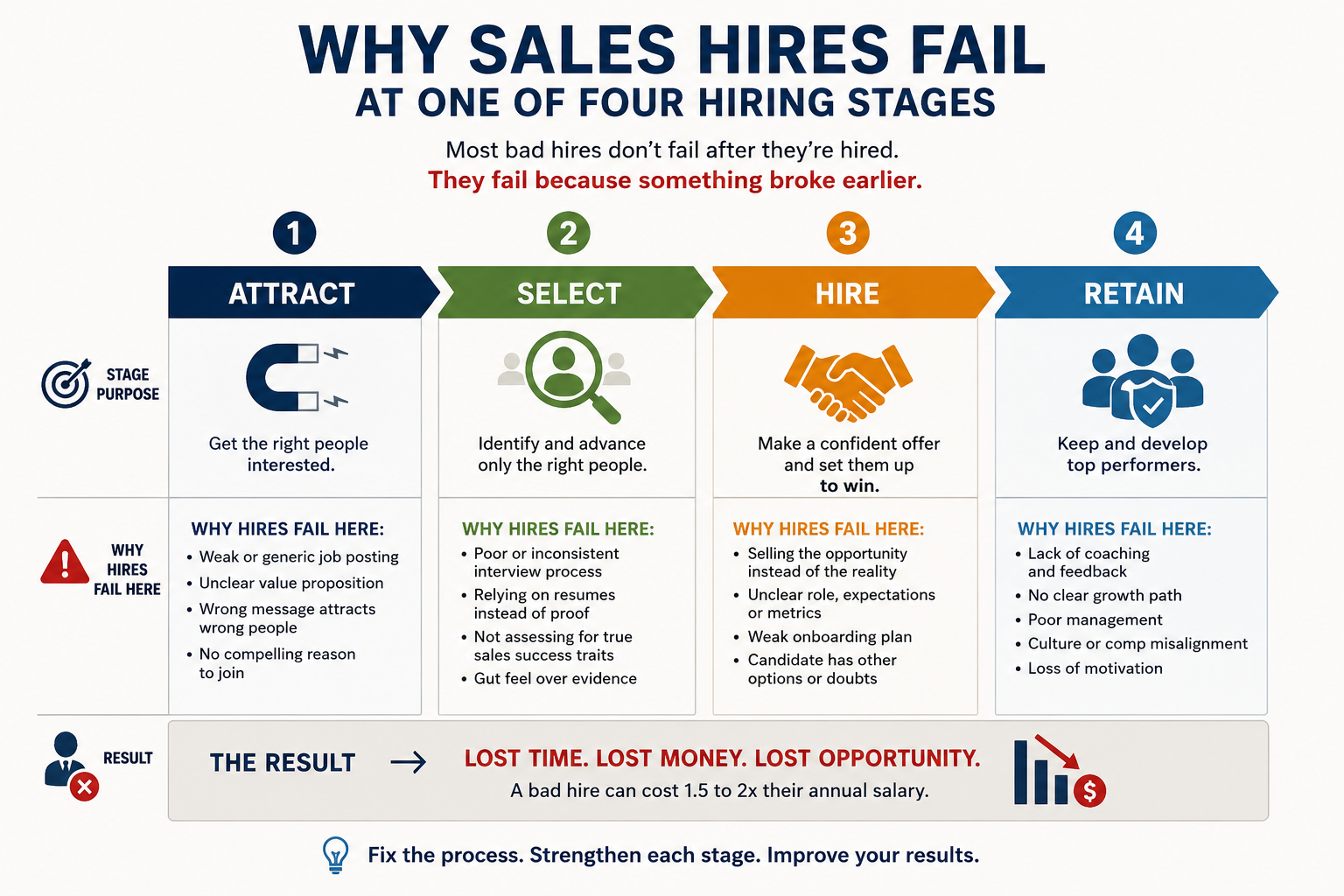
Why Sales Hires Fail: The Machine Breaks in One of Four Places
Your last three sales hires failed three different ways.
One never filled the pipeline. One interviewed like a champion and sold like a spectator. One took the offer, dragged through onboarding, and quit at month nineteen — right when the ramp math was about to turn.
You've been treating those as three separate stories. Three unlucky picks. Three "wrong fits."
They're not three stories. They're one machine, breaking in three different places — and if you can't name where your machine breaks, you're not running a sales hiring process. You're running a slot machine with a $125,000 pull.
If reading that makes you defensive, this isn't for you. If it makes you want the diagnosis, keep going.
Stop Blaming the Candidate for a Machine You Never Built
Here's the belief that keeps the cycle spinning: *sales hiring is a people problem. We just keep picking the wrong person.*
So you sharpen your picker. You trust your gut harder. You add an interviewer. You tell your sales leader to "really dig in this time."
And the machine keeps breaking — because the machine was never the candidate.
Hiring salespeople is a system with four stages: Attract, Select, Hire, Retain. Every hiring failure you've ever eaten happened at exactly one of them. Not "somewhere in the process." One stage. The problem is that the pain shows up downstream from the break — so you keep repairing the stage that hurts instead of the stage that failed.
That's why sales hires fail on repeat: CEOs feel the pain at one stage and rebuild a different one.
Read the Symptom, Find the Stage
The machine tells you where it's broken. You just have to read the gauge. Four symptoms, four diagnoses:
Empty pipeline of candidates? Attract is broken.
Nobody good is applying. You blame the labor market. The labor market didn't write your three-word job posting. A vague posting attracts vague candidates — and repels the killers who want to know exactly what the seat demands.
Wrong people advancing? Select is broken.
Charmers keep making it to the final round. That's not bad luck — that's what happens when the interview is the test and the candidate is a professional persuader. The interview is a buyer simulation, and they're winning it. Remember the Resume Lie — the first blind spot in the series? It lives here.
Offers declined or slow starts? Hire is broken.
You found the right person and lost them at the offer — or landed them and watched them stall for a quarter. The Hire stage is where the offer gets sold and the seat gets priced. Get either wrong and the best candidates walk while the desperate ones sign.
Good reps gone by month 20? Retain is broken.
You finally hired a producer and they left right after ramp. That's not a loyalty problem. That's an onboarding, positioning, and cadence problem — the stage you told yourself was HR's checkbox.
Four symptoms. Four stages. One rule: the symptom shows up downstream; the break is always upstream.
Count What the Wrong Diagnosis Costs
A bad sales hire costs $125,000. You've likely paid it more than once — most construction and distribution CEOs in the $25M–$50M range have paid it three or four times before they ever question the machine.
Now stack the odds you're working against. OMG has assessed more than two million salespeople: 6% are elite, 14% are good, 20% are above average — and 60% are mediocre to poor. That distribution doesn't change by industry. Without a working machine, you're drawing from that deck blind, and unstructured sales hiring succeeds about 20% of the time.
A built machine flips it. Hiring success moves from 20% to 80% when every stage runs on process instead of hope. Same labor market. Same candidates. Different machine.
The wrong diagnosis is what keeps you paying. Rebuild Select when the break is Attract, and you've spent a quarter tightening interviews for a pipeline that never contained the right people.
Run the Diagnosis Like You'd Run an IDS
You run EOS. You'd never let ops report "the plant feels off" and call it identified. So stop letting sales hiring stay at "we keep picking wrong."
Bring it to your Leadership Team L10 and IDS it properly:
1. Name the symptom out loud.
Empty candidate pipeline, charmers advancing, offers dying, ramped reps leaving. Pick the one that actually describes your last two failures — not the one that's easiest to admit.
2. Map it to the stage.
Use the four diagnoses above. The room will want to jump to solutions in the wrong stage. Don't let it. Identify before you solve — you already know how this discipline works.
3. Rebuild that stage only.
One stage, done properly, beats four stages patched. A posting rebuilt to attract-and-repel. A structured, evidence-based Select with a Predictive Sales Assessment in front of the interview. An offer that sells the seat. An onboarding that installs the message before the catalog.
Three moves. Same discipline you already run everywhere else in the business — finally aimed at the one department still running on gut feel.
You'll Want to Say "We Just Need the Right Person"
That's the objection, and it's the blind spot restated. "Right person" thinking is how you've hired for a decade — and it's produced the exact revolving door you're reading this to escape.
The right person walked into your process before. Your machine lost them at Attract (never applied), at Select (lost to a charmer), at Hire (took a sharper offer), or at Retain (left at month 20). Right person, right seat only works when the machine that fills the seat works.
You Can't Train Your Way Past a Broken Machine
Here's where most CEOs go next — and it's the most expensive wrong turn on the map. The reps aren't producing, so you buy sales training.
Training assumes the machine put the right people in the seats. If Select is broken, you're funding a semester for students who should never have been admitted — and you can't coach a salesperson into someone you should have hired. Diagnose the machine first. Then decide what the people in the seats actually need.
The symptom shows up downstream. The break is always upstream.
Get Out of the Slot-Machine Business
Picture the other side of this. A candidate pipeline with real sellers in it. A Select stage that catches charmers before you do. Offers that land. Reps still producing at month 30. A hiring machine you own — one that works on every hire after, the way the Helix sales hiring process has worked inside 27 EOS-running construction and distribution companies.
Two ways forward, pick your speed:
Fast: Book an Alignment Call . Thirty minutes. Bring your last two hiring failures; leave with the stage that broke.
Thorough: Read *Inside Out: Why Strong EOS Companies Have Weak Sales Teams* — the full diagnosis of why the machine breaks inside companies that run everything else on process. On Amazon: https://amzn.to/4umsNkR
And if you want this thinking every week, the diagnosis continues in the Sales Velocity newsletter — one hiring or selling reframe, every week, no fluff.
Frequently Asked Questions
Why do sales hires fail so often?
Sales hires fail because the hiring machine breaks at one of four stages — Attract, Select, Hire, or Retain — and most companies rebuild the wrong stage. Unstructured sales hiring succeeds roughly 20% of the time; a staged, evidence-based sales hiring process moves success to about 80%.
What is a sales hiring process?
A sales hiring process is a defined, repeatable system covering four stages: attracting the right candidates, selecting with objective evidence instead of interview impressions, selling and structuring the offer, and retaining the hire through real onboarding. If any stage runs on gut feel, the whole machine inherits that stage's failure rate.
How do I know which hiring stage is failing?
Read the symptom. An empty candidate pipeline means Attract failed. Wrong people advancing means Select failed. Declined offers or slow starts mean Hire failed. Good reps leaving around month 20 means Retain failed. The symptom always shows up downstream of the break.
Why do salespeople fail even after sales training?
Because training can't reverse a hiring miss. OMG's data on two million assessed salespeople shows 60% are mediocre to poor — if your Select stage let one through, no curriculum changes their Sales DNA. Diagnose the hiring machine before spending on the people it produced.
Walter Crosby | The Sales Integrator™ | helixsalesdevelopment.com